
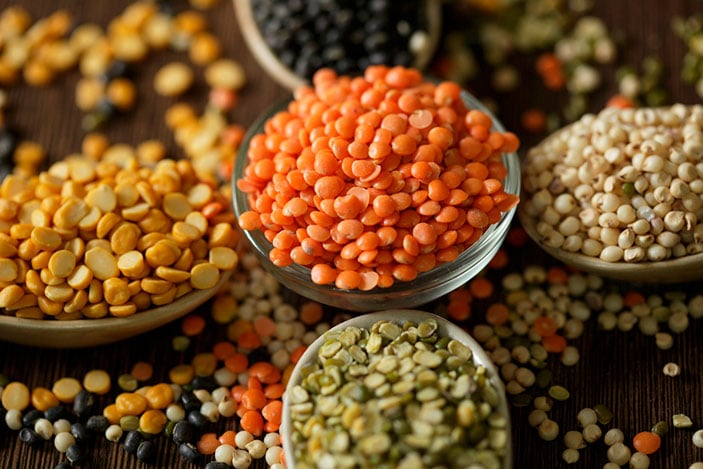
Lentils, a dietary staple of world cuisines such as Indian, Nepalese, Greek and Italian, are a wonderful and sometimes-overlooked plant-based food. Lentils come in many varieties ranging in color from black and various shades of brown to red, orange, yellow and slate green. As you can see below, there are many nutrition and health benefits to be had from including an ample supply of lentils in your diet:
Nutrition and Health Benefits
• A cup of lentils has 18 grams of protein, almost as much as beef, which has 22 grams of protein per cup. Among legumes, lentils are the second highest in protein, after soybeans.
• Lentils cook quickly, taking generally 30-45 minutes to soften depending on the variety. They also don’t require hours of pre-soaking like many other types of beans do, so cooking them requires less advance planning.
• Lentils are relatively inexpensive compared to other plant and animal-based protein sources, such as fish, cheese, beef, chicken, tempeh (fermented soy) and seitan (wheat gluten “meat”).
• At 3.5 grams of sugar per cups, lentils are low in sugar and have a low glycemic index.
• Lentils contain virtually no fat.
• Lentils are one of the easiest beans to digest.
• Lentils are low in calories, with one cup having about 230 calories for those 18 grams of protein.
• Lentils are a good source of soluble dietary fiber, which supports gut and heart health and stabilizes blood sugar.
• In addition to being a good source of protein and fiber, lentils are high in many vitamins and minerals that are required for good health. Lentils provide 90 percent of the daily value for folate (vitamin B9), 47 percent of the daily value for manganese, 37 and 36 percent for iron and phosphorous, respectively, more than 20 percent of the daily value for copper, thiamine (vitamin B1) and potassium, and significant amounts of magnesium, vitamin B6, zinc and vitamin B5.

• Best of all, lentils are very tasty and highly-suitable for many types of dishes, such as soups, stews, entrees, salads and spreads. If you’re curious, be sure to check out my recipes for Hearty Lentil Kale Soup, Indian Mulligatawny Soup, Lentil Shepherd’s Pie, Lentil Cucumber Salad, and Moroccan Stew with Kale. – all of which are of course delicious, if I say so myself! Another great way to take advantage of lentil nutrition benefits is through gluten-free lentil pasta, available at Trader Joe’s and at other retailers.
A Seemingly Endless Variety

Lentil Shepherds Pie
Lentils come in four basic varieties: brown, green, red/yellow and specialty lentils, such as black beluga, and brown lentils such as petite castillo and Spanish pardina, among many others. The different varieties are distinct in texture and flavor but have similar nutritional profiles.
Brown and green lentils are commonly used in most recipes that call for lentils, and they tend to retain their shape. Red, orange and yellow lentils are split and tend to disintegrate more easily, so they are good for soups such as Indian lentil dahl, and stews or spreads.
Black beluga lentils as it turns out, are available at of all places Target, as well as at Whole Foods Market and online at Vitacost. Spanish pardina lentils seem to be a little harder to find, but they are available online at Woodland Foods, while petite castillo lentils are available online at Purcell Mountain Farms. Puy lentils, which are slate green in color, are also available online at Merchant Gourmet. They are known for their slightly peppery flavor.
Be brave and be bold! Try something new. If you’re already familiar with plain old brown lentils, try a red/yellow variety or one of the exotics that you have to get online. And if you’re not familiar at all with lentils, then start small with the common brown, or brewer, variety.
But whatever you do, make a place for lentils in your kitchen and on your plate, and do it soon! Your friends and family will thank you.
And so will your body!
I hope you enjoyed this article. Want more of Plant-Based Cooking?
Connect with me on Facebook, Twitter, Pinterest, or Instagram.


Leave a Reply